jdVOID: A Weekend Arena Duel, Written in BASIC
My son and I wanted something to play against each other. Not on the couch. On our phones, from wherever we happen to be.
So we built it. Two days, one language, no engine.
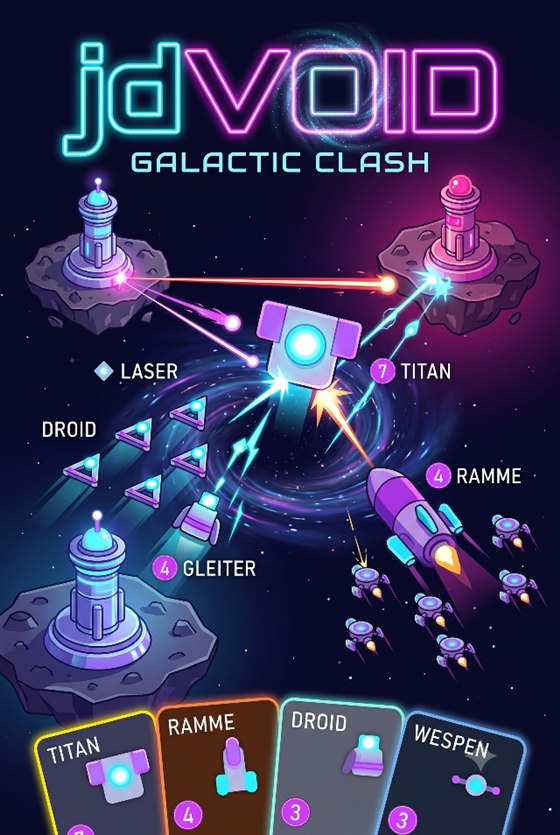
jdVOID is a two-player arena duel in the Clash Royale tradition. You spend elixir, you drop ships, the ships walk at the enemy stations and shoot whatever gets in the way. Three minutes, plus overtime. Whoever knocks down more stations wins.
The whole thing is jdBasic. The match server is jdBasic. The client on the phone is jdBasic. The rules are one module both of them import.
One file owns the truth
arena.jdb knows the rules and nothing else. No graphics, no network, no files. It exports a handful of functions over a state map that is plain JSON all the way down.
IMPORT ARENA

st = ARENA.NEWGAME()
msg$ = ARENA.PLAYCARD(st, pid, "KOLOSS", 4.0, 20.0)
st = ARENA.SIMSTEP(st)
The server imports it. The client imports it. The balance harness imports it. There is exactly one place where a unit decides what to attack, so the phone and the server can never disagree about the rules, only about the clock.
And because the state is a JSON map, the server does not have to serialize anything. It hands the map to JSON.STRINGIFY$ and that is the wire protocol.
The server does nothing until asked
There is no simulation thread. Nothing ticks in the background. When a client asks for the state, the server looks at the clock, works out how many 0.1 second steps it owes, runs them, and answers.
A room nobody is watching costs zero, and so do twenty idle ones. The simulation only exists while somebody is looking at it, which is how this runs on a shared box.
Rooms are created on demand by name. That was the answer to "can my colleagues play too". They pick a room name, and two pairs never see each other.
The client is the same language, in a browser
jdBasic compiles to WebAssembly. The page fetches royale.jdb over HTTP, drops it into the virtual filesystem, resolves the modules it imports, and runs it. No transpiling, no second implementation, no JavaScript in the game.
A link carries the session:
play/?prog=royale&fs=1&name=Atomi&room=main&lang=enThat was the actual requirement from my son. Gen Z does not type program names into a REPL. They tap a link. So the site root is a poster page with three fields, and it forwards to the URL above with the canvas taking the whole screen.
The page also hands the program its own origin, and the client turns that into its API base. The same file runs against localhost and against production without a rebuild.
Nobody here can draw
I have no artist. I have an array language.
Every ship is three to five signed distance fields. A disc, a rounded box, a bar. The rasterizer evaluates them over the whole pixel grid at once, adds a glow pass, and hands the finished RGBA buffer to SPRITE.SETBUFFER. It runs once at startup and after that the GPU does the work.
' a card is data, not a special case in the code
"BRUTSCHIFF": { "COST": 5, "HP": 900, "DMG": 55,
                "SPAWNS": "NANOS", "SPAWNRATE": 3.0, "SPAWNN": 2 }
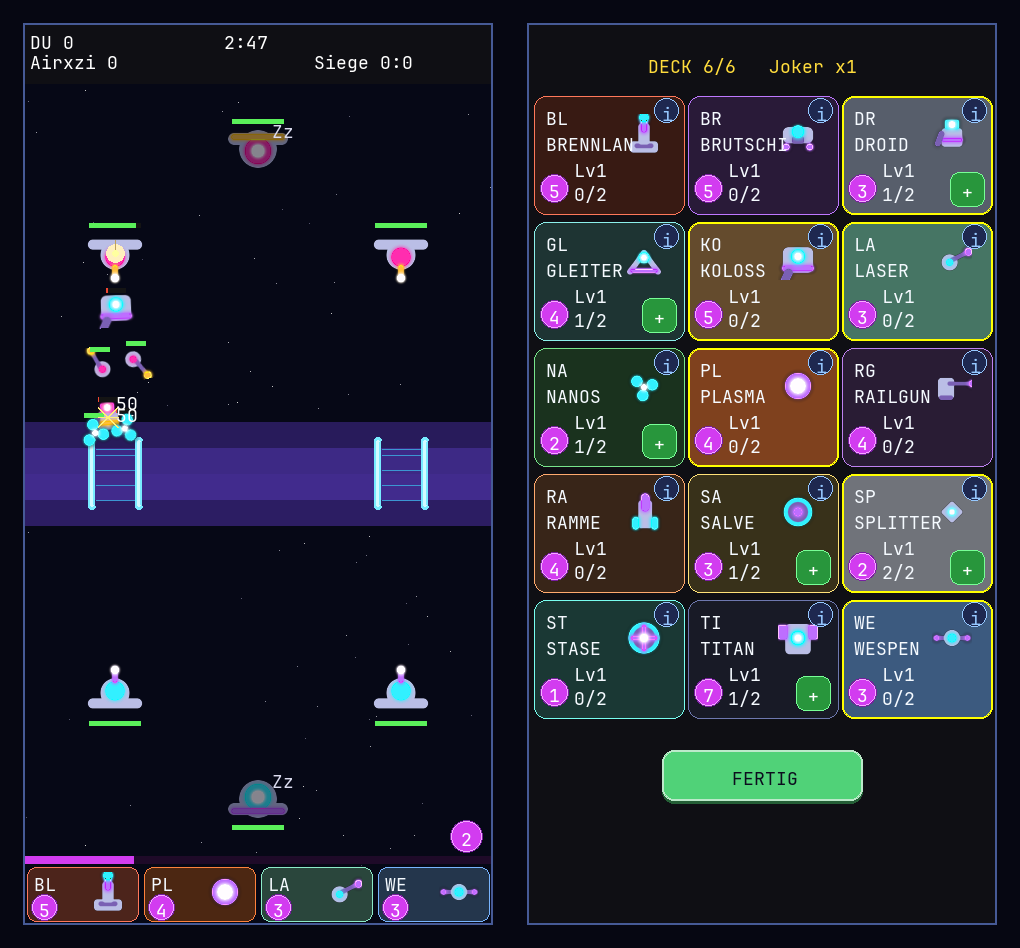
Cards are traits, not classes. FLY ignores the river. ONLYTOWERS walks past troops. BUILD never moves. TTL makes a building temporary. SPAWNS hatches a brood on its own clock. A new card is a few lines in a JSON file and a shape in the rasterizer. Fifteen of them shipped over the weekend, the last three on Saturday evening because my son declared that Titan was stupid.
The loser gets the same chest
Every finished match hands both players five common cards, two strong ones and a wildcard. Win or lose. That is not a design principle, it is family diplomacy. I lose most of them.
Levelling a card costs 2, 4, 8 or 16 copies. Wildcards fill the gap. Everything is keyed by player name in one JSON file next to the server.
What the weekend changed
Voice stealing in the mixer. A sustain level that never releases fills the 64 voice pool and the allocator runs dry. The music uses a long decay now, and the engine steals the quietest sustaining voice when nothing is free. Measured with SOUND.RENDER: peak amplitude 0.001 before, 0.112 after.
A random generator in the VM state. The C runtime keeps its random state per thread, and chests are dealt on HTTP handler threads, so seeding RND() on the main thread reaches none of them. jdBasic carries its own generator now.
Pointer coordinates on a scaled canvas. A phone canvas is scaled, so window coordinates land somewhere else. And the event handler hands its payload as an array, not a map.
HTTP.SERVER.WAIT. A SLEEP loop as the main loop runs VM bytecode on the main thread while HTTP handlers run on theirs. HTTP.SERVER.WAIT parks the main thread instead and leaves the handlers to the server.
Play it
It is live at vvss.jdbasic.tech. Pick a name, pick a room, send the link to somebody. It runs in a phone browser, no install, no store.
The whole source is in the jdBasic repo under jdb/demos/games/basicroyale, with a README that covers the architecture, the endpoints and the box setup. And jdBasic itself lives at jdbasic.org, where you can try the language in your browser.
Two days. A language I wrote myself. And a son who beats me at my own game.